
A Concussion Is Not Just an Injury — It Can Be a Reboot
One of the most confusing parts of traumatic brain injury is that it doesn’t just affect memory or attention. It affects identity.
Many survivors describe a strange feeling after concussion:
“I’m still here… but I’m not the same.”
Most medical explanations stop at symptoms. They describe neurotransmitters, inflammation, and recovery timelines. Those are important. But they don’t fully explain the experience.
To understand what many survivors actually feel, it helps to think about the brain a different way.
Not as broken hardware.
But as software that just rebooted.
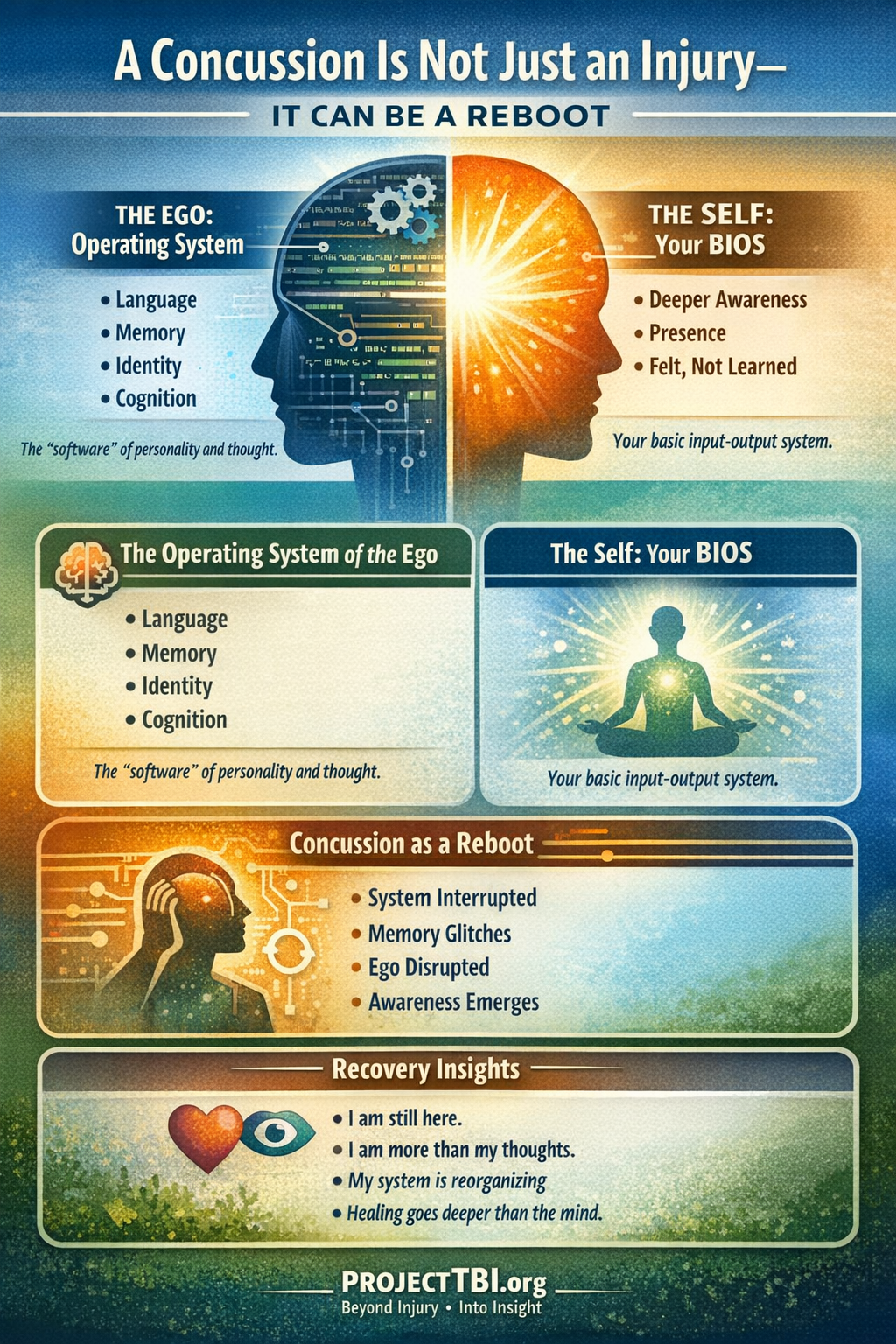
The Ego Is an Operating System
Language is the programming of the ego.
From the moment you are born, your brain installs updates:
Where you grow up
What language you hear
How your family communicates
What school teaches you
What culture repeats
What media reinforces
Over time, all of this becomes your internal operating system.
It shapes:
how you think
how you interpret events
how you explain yourself
how you understand your place in the world
Education adds patches.
Experience adds plugins.
Trauma sometimes rewrites entire sections of code.
Eventually, identity feels inseparable from the system itself.
But it isn’t.
Under the Operating System Is Something Older
Beneath language, memory, and personality is something simpler.
Call it awareness.
Call it presence.
Call it being.
If the ego is the operating system, then the deeper self is the BIOS.
It isn’t learned.
It isn’t programmed.
It doesn’t depend on vocabulary.
It doesn’t disappear when memory struggles.
It is felt more than explained.
Many survivors discover this layer only after injury interrupts the one above it.
Writers like Eckhart Tolle describe this as presence. In the TBI community, people often describe it more simply:
“I’m still me… even when my brain isn’t working right.”
That statement is profound.
It means identity exists deeper than cognition.
What a Concussion Actually Interrupts
A concussion disrupts the operating system layer first.
Words slow down.
Attention fragments.
Memories become harder to access.
Emotional regulation changes.
The interface between thought and expression becomes unstable.
This feels frightening because our culture teaches us that thinking is identity.|
But survivors often report something unexpected:
Even when thinking changes, something steady remains underneath.
That realization can become a turning point in recovery.
The Reboot Experience
One way to understand concussion is this:
It forces a reboot between the operating system and the deeper self.
During that reboot, the brain is reorganizing.
Connections are being repaired.
Priorities shift.
Old habits sometimes fall away.
New sensitivities appear.
Many survivors say they notice things differently afterward:
Light
Noise
Conversation
Emotion
Meaning
Sometimes they even describe a stronger connection to what feels real and immediate.
Not everyone experiences this.
But enough people do that it deserves attention.
Recovery Is Not Just Restoration
Traditional rehabilitation focuses on restoring previous performance. And that matters.
Memory matters.
Attention matters.
Speech matters.
Executive function matters.
But recovery is not only about reinstalling who you were before injury.
Sometimes it includes discovering who you are underneath the programming that came before it.
This perspective does not minimize concussion.
t respects how disruptive it can be.
At the same time, it recognizes something survivors already know:
Even when the operating system struggles…
the person is still there.
Why This Matters for the TBI Community
At ProjectTBI.org, we collect survivor experiences because recovery is not only neurological.
It is personal.
It is emotional.
It is identity-level work.
If concussion truly functions like a reboot for some people, then survivor insight is not just anecdotal.
It is data.
And understanding these experiences may help future patients recognize something earlier in their recovery:
You are not disappearing.
Your system is reorganizing.
And sometimes, in that process, people discover parts of themselves they never noticed before the injury.