I Let My Dogs Teach Me How to Heal
About two and a half years after my accident, I started noticing something I hadn't expected.
My mind felt clearer.
Not overnight. Not dramatically. No switch was flipped. But slowly — almost quietly — something was changing. My thinking felt more stable. My emotions were more even. My days felt more predictable. And the thing that seemed to be helping most wasn't a therapy or a supplement or a new routine I had carefully designed.
It was my dogs.
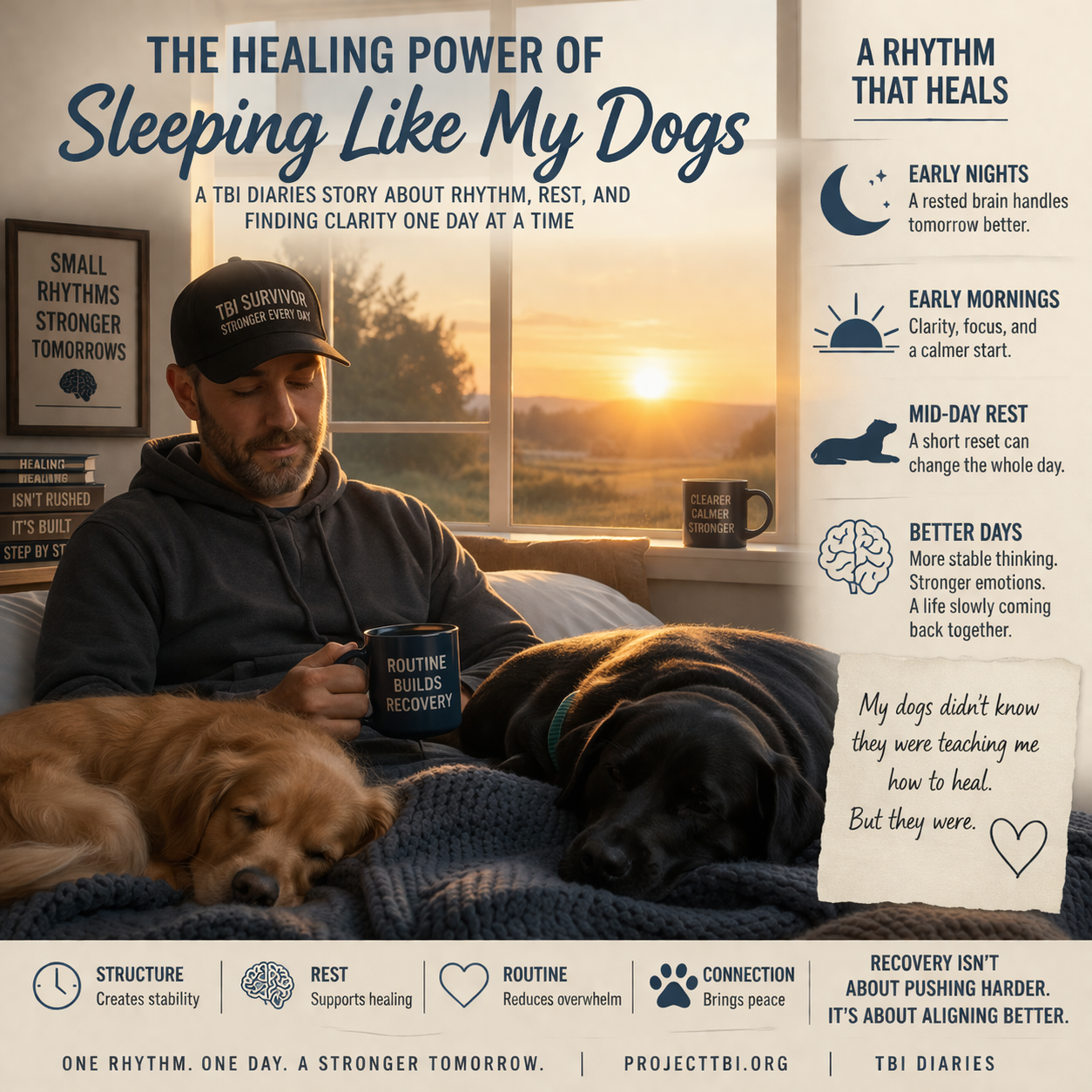
They go to bed early. They wake up early. They rest in the middle of the day. And without planning it — without even fully realizing it at first — I had started doing the same thing.
For a long time after my concussion, sleep didn't feel like recovery. It felt like surrender. I rested because my brain forced me to. It didn't feel productive. It felt like time I was losing, not time I was using.
"Somewhere along the way, sleep stopped feeling like a limitation and started feeling like structure."
As I leaned into that rhythm — early nights, early mornings, a mid-day reset — I noticed something real. My brain handled the day better. Decisions were easier. Conversations were easier. Small frustrations didn't feel as devastating.
It reminded me of something from earlier in my life. During my time in the military, my days had shape. There was a rhythm to everything — wake times, movement, work, rest, repeat. I hadn't thought about that connection consciously. But somewhere in my nervous system, I think my brain still wanted that kind of cadence. My dogs were living it naturally. I just had to follow their lead.
There was something quietly powerful about accepting that recovery didn't require pushing harder. Sometimes it required moving more naturally. More gently. In sync with something outside myself.
What This Teaches Other Survivors
Your brain after injury is not the same brain that could override fatigue on command. It is asking for something different now. It is asking for rhythm, predictability, and permission to rest without guilt.
You don't have to engineer a perfect schedule. Sometimes you just need to notice what's already working — even if that guidance comes from the quietest, most unexpected sources. For me, it came from two dogs who had no idea they were helping me heal.
Sleep is not lost time. It is repair time. And the rhythm you follow doesn't have to look like anyone else's.
What Caregivers Should Understand
When someone with a TBI says they need to sleep — again — they are not being lazy. They are not avoiding life. They are doing some of the most important work of their recovery, and it happens in the quiet.
If you're supporting a survivor, one of the most valuable things you can offer is an environment that protects their rhythm. Reduce noise during rest periods. Avoid scheduling things in the late evening. Help them guard their sleep the way you would guard any medicine — because for a healing brain, it is.
Practical Takeaway
If you're in recovery, try this
Notice what time your body actually wants to sleep — not what you think it should be.
Try one week of consistent early nights and early mornings and observe how the day feels differently.
Give yourself permission for a mid-day rest, even 15–20 minutes. Many survivors find it genuinely changes afternoon cognition.
Pay attention to what's already working around you. Sometimes healing wisdom lives in the most ordinary places.
Remember: following your body's rhythm is not giving up. It is one of the most disciplined things you can do in recovery.
Recovery doesn't always announce itself. Sometimes it arrives quietly — in the way a morning feels a little softer, a decision comes a little easier, a day feels a little more manageable than the last. If you're still in the middle of it, keep going. Your brain is working, even when you can't feel it working. Sometimes the most healing thing you can do is rest, follow the rhythm, and trust the process you can't always see.