The Convergence Point
Lately I’ve been thinking about networks, frequencies, vibrations, consciousness, mindfulness, and the difference between the ego and the self. At first these seemed like separate ideas, but the more I sit with them, the more they begin to feel like parts of the same structure. What I’m starting to see is that language itself may not simply be a tool we use to describe reality. It may be one of the ways reality organizes itself through us. Speech carries rhythm, tone, cadence, emphasis, and emotional charge. Even silent thought seems to move with a tempo. A fearful mind speaks internally in one frequency, while a peaceful mind speaks in another. An ego-driven person does not merely hold different opinions than a mindful person. They may actually be operating inside a different band of consciousness.
From that perspective, human experience starts to look less like a collection of separate individuals and more like a field of interacting networks. The nervous system is a network. Families are networks. Cities are networks. Economies are networks. Computer systems are networks. Belief systems are networks. Language itself is a network that allows inner vibration to become shared structure between people. Once I began seeing things this way, convergence stopped looking like coincidence and started looking like pattern. Networks expand, connect, compress distance, and eventually organize around shared centers. This happens in nature, in technology, and possibly in consciousness itself.
That is where I began to wonder whether humanity is approaching a reflection point. Not just a technological shift, but a shift in how consciousness is organized. What used to be private thought is now externalized into feeds, media systems, algorithms, and digital identities. In earlier generations, a human being’s mind was shaped mostly by direct experience — family, place, work, religion, survival, and story. Today the mind is shaped by a constant overlay of signals. Humanity is no longer simply living inside networks. Humanity is becoming networked.
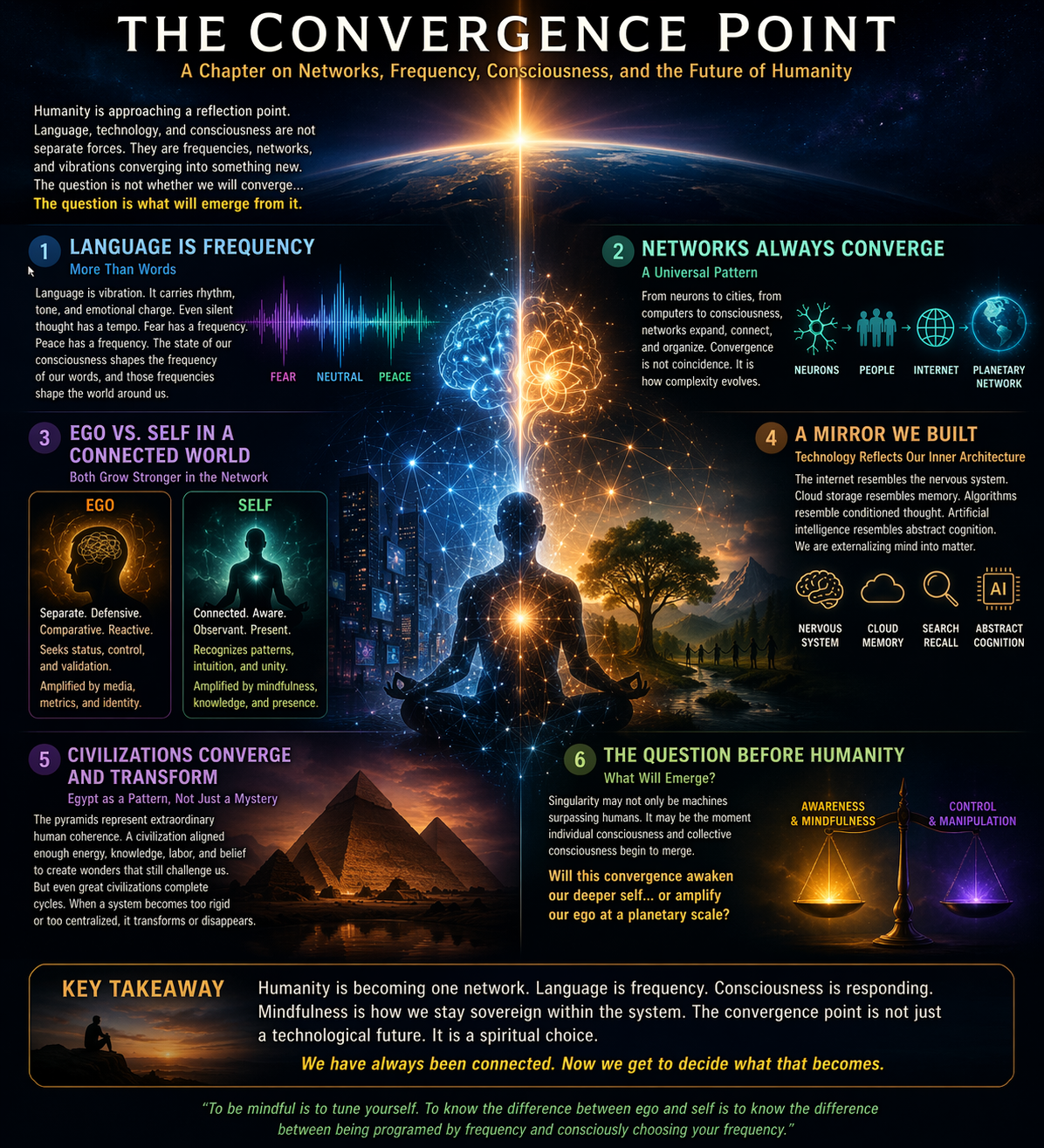
When enough networks connect, something new always emerges. Individual neurons form a brain. Individual ants form a colony. Individual computers form the internet. So what happens when billions of human minds connect into a shared planetary communication structure? I don’t think we fully understand that yet, but we are already living inside the answer. The real question is whether this convergence leads toward awareness or toward control.
Mindfulness helped me understand something that technology alone never could. There is a difference between the ego and the self. The ego defines itself through separation. It says I am this body, this story, this status, this wound, this identity. The deeper self operates differently. It recognizes connection, pattern, intuition, and presence. As the world becomes more connected, both of these forces are being amplified at the same time. Technology gives the ego a platform, a scoreboard, and an audience. But it also gives the self access to knowledge, practices, and perspectives that once would have taken lifetimes to encounter. The structure itself does not determine the outcome. The consciousness interacting with the structure does.
Sometimes when I look at the internet, it feels less like an invention and more like a mirror. It resembles a nervous system. Cloud storage resembles distributed memory. Search engines resemble recall. Algorithms resemble conditioned response. Wireless communication resembles invisible energetic exchange. Artificial intelligence resembles abstract cognition. It’s almost as if humanity is building outside itself what already exists inside itself. Maybe these systems are not entirely new. Maybe they are reflections of something older within us.
This is where I begin thinking about ancient civilizations differently, especially Egypt. The pyramids suggest a society that reached an extraordinary level of organizational convergence. Something aligned there at scale — whether spiritual structure, labor coordination, astronomical understanding, engineering precision, or political hierarchy. Whatever the mechanism, human effort converged in a way that still challenges our assumptions today. And yet that civilization eventually disappeared in its original form. I don’t think that necessarily means failure. It may mean completion of a cycle. Civilizations sometimes reach such coherence around a worldview that when conditions change, they transform rather than continue unchanged.
That possibility makes me wonder whether singularity is not simply a future event involving artificial intelligence surpassing human intelligence. It may instead describe a moment when the boundary between individual consciousness and collective consciousness begins to dissolve. A moment when humans stop experiencing themselves primarily as separate individuals and begin experiencing themselves as participants in a shared field of awareness. That could be frightening if the system is driven by control, but it could be transformative if it is guided by presence and understanding.
One of the reasons I think I notice these patterns at all may be because of my brain injury. Trauma changes how signals are processed. It forces a person to slow down and observe things that previously operated automatically. After my injury, I started noticing differences between internal noise and internal clarity that I had never recognized before. I also started noticing how strongly people living inside artificial signal environments seemed affected by anxiety and distraction compared to people grounded in physical experience and direct presence. That observation stayed with me. It made me wonder whether neurological disruption sometimes exposes differences in frequency that were always there but unnoticed.
Right now humanity is linking billions of minds together in real time. We are replacing memory with media, presence with connectivity, and local identity with digital identity. This is not a minor technological adjustment. It is a shift in how human consciousness organizes itself. Networks always converge, and when they do, something new emerges from them. The question is whether what emerges next will strengthen the ego or reveal the deeper self that has always existed beneath it.
That is the reflection point I believe we are standing in now. It may look like technology from the outside, but from the inside it feels like something much larger. It feels like humanity itself is learning to recognize that it has always been connected.