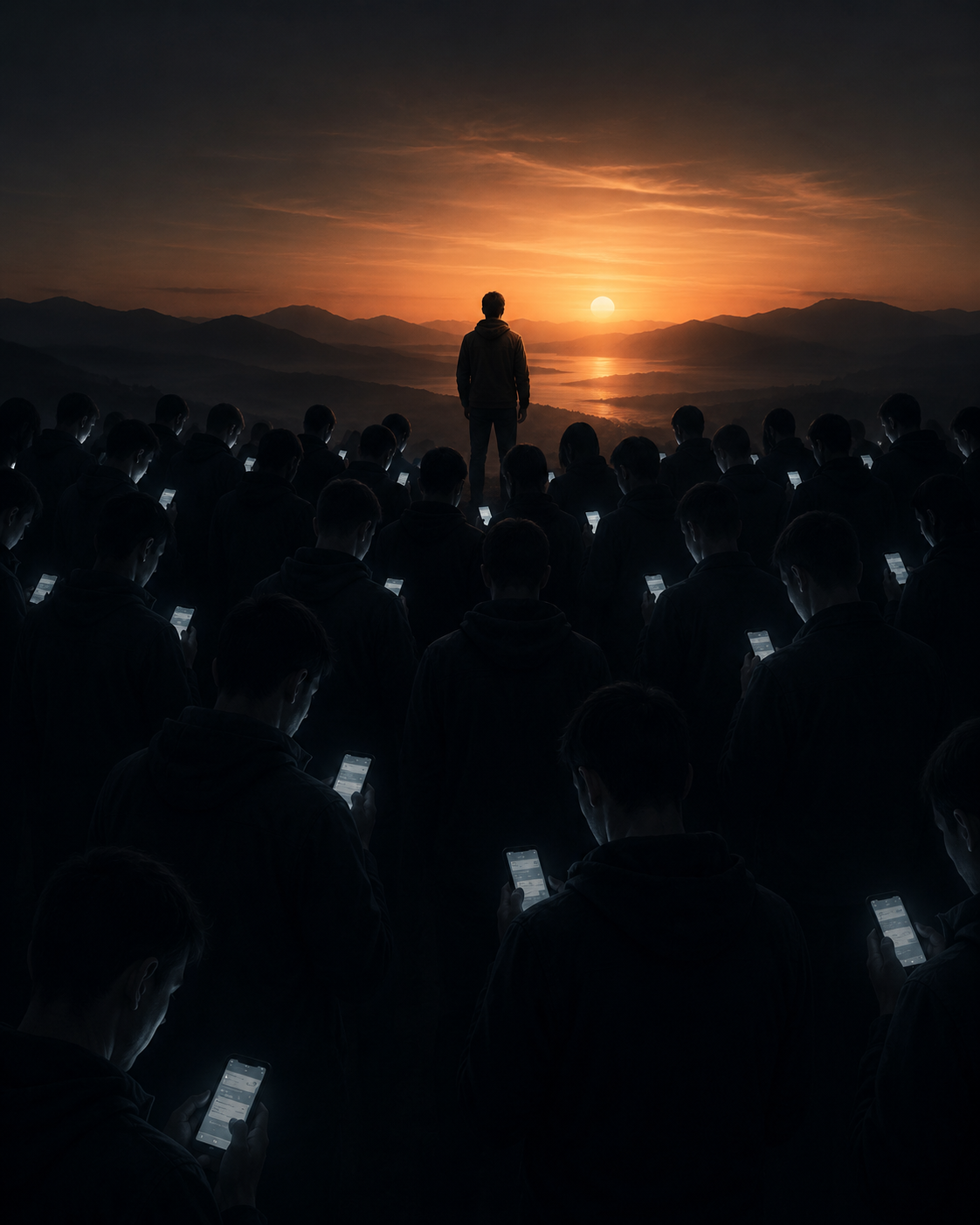
There may be no greater crisis facing humanity than this: We no longer live where we actually are.
For most of human history, consciousness existed primarily in the present moment. People experienced life directly — through conversation, weather, silence, work, struggle, nature, touch, community, and memory tied to real physical experiences.
Now, much of humanity lives inside screens.
And screens are almost always showing the past.
Every scroll is yesterday.
Every video already happened.
Every post is a memory.
Every argument is a replay.
Every outrage cycle is recycled emotion.
Even “live” media occurs somewhere else, at another time, in another space, filtered through algorithms and advertisements before it reaches your nervous system.
Human beings have become psychologically detached from the present moment because attention itself has become outsourced.
This may explain why anxiety, dissociation, ADHD-like symptoms, emotional numbness, and chronic overstimulation have exploded in modern society.
The brain was not designed to absorb thousands of artificial memories every day.
And maybe this is why many TBI survivors and neurodivergent individuals notice something others don’t:
After injury, overload becomes impossible to ignore.
Many begin withdrawing from constant stimulation, endless feeds, noise, and artificial emotional loops. Some rediscover silence. Presence. Simplicity. Nature. Routine. Direct experience.
Not because they are broken —
but because their nervous systems can no longer comfortably tolerate the nonstop fragmentation of attention modern society calls normal.
A traumatic brain injury can force someone to become intensely aware of where their consciousness is being directed.
And in that awareness, many rediscover something the modern world forgot:
Life only happens now.
Not on the feed.
Not in the replay.
Not in the algorithm.
Now.